


A Diplomatic Review Analysis Based on the Testimony of Professor Priit Rohtmets, Associate Professor of Church History at the University of Tartu, Estonia.
In a series of exchanges, Professor Priit Rohtmets, one of Estonia’s leading historians of religion, offered a detailed and nuanced account of the relationship between Churches and state power in the Soviet Union and the Baltic region. His insights illuminate a broader geopolitical dynamic: the interplay between religious institutions, imperial governance, and strategies of ideological control that have shaped Eastern Europe from the early Bolshevik period to the present.
The Soviet Strategy: From Persecution to Instrumentalisation
Drawing on archival research and historical analysis, Professor Rohtmets underscores that the early Bolshevik regime perceived religion as fundamentally incompatible with communist ideology. The 1920s brought confiscations of Church valuables, mass repression of clergy, and the forced closure of countless parishes. The creation of the “Living Church”—a schismatic body engineered by Soviet authorities—was intended to “sow confusion” and weaken the Russian Orthodox Church (ROC). Professor Rohtmets explains: “Together with the promotion of atheist work and the creation of the so-called movement of the ‘godless’ (bezbožniki), the authorities sought to neutralise the Church. In 1922, Patriarch Tikhon of Moscow was arrested and kept under house arrest until June 1923 because he had dared to criticise the nationalisation of Church property.”
However, as the professor continues, the Soviet state soon recognised the political potential of a controlled religious institution. The turning point came a couple of years later, as “after Tikhon’s death in April 1925, the Church was not permitted to elect a new Patriarch and therefore only the Patriarchal Locum Tenens continued as Church leader.” In July 1927, the latter, Metropolitan Sergius (Stragorodsky), issued a declaration of loyalty to the Soviet government. From this moment, the ROC’s cooperation with the regime started to deepen, not only as a survival strategy but as a shared tool for projecting influence at home and abroad.
The formal change took place under Stalin during the Second World War. Pressured by Western allies—particularly President Roosevelt—he revived limited Church activity and encouraged the ROC to serve as an instrument of Soviet foreign policy. Attempts to convene an ecumenical council in Moscow in 1948 fit squarely within this diplomatic strategy, signalling to the world that religion remained active under Soviet rule while reinforcing the state’s geopolitical narrative.
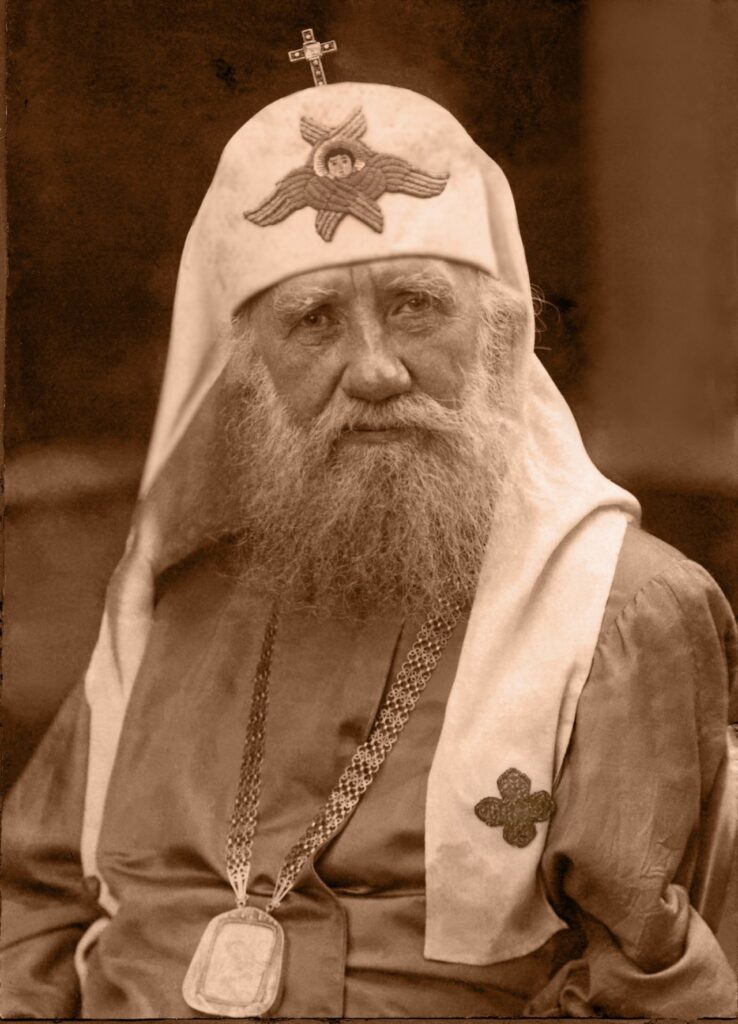
Patriarch Tikhon of Moscow
The Baltic Exception and the Question of Church Autonomy
Professor Rohtmets notes that the Baltic region occupies a unique position in this history. Estonia, Latvia and Lithuania became independent democratic states in 1918 and when the Bolshevik persecutions began in the Soviet Union, several Orthodox communities—including those in Estonia, Latvia, and Finland—chose to leave the jurisdiction of the ROC and place themselves under the Ecumenical Patriarchate of Constantinople. In these countries, where religious freedom was respected during the interwar period, Orthodoxy developed independently and was not subjected to the extreme repression experienced in Soviet Russia.
The Soviet annexations of 1940 overturned this autonomy. According to the professor, the ROC, working hand-in-hand with the occupying authorities, reincorporated the Baltic Churches in violation of canonical norms. When Estonia restored independence in 1991, the same tensions resurfaced: the ROC refused to acknowledge the continuity of the pre-war Orthodox Church of Estonia, asserting instead its own jurisdictional claims.
These disputes, Professor Rohtmets argues, reveal the imperial identity of the contemporary ROC, which continues to function as an extension of Russian geopolitical strategy. Its insistence on jurisdiction over Ukraine, the Baltic states, and parts of Central Europe reflects not ecclesiastical necessity but the lingering logic of empire.
Clergy, Surveillance, and the Politics of Collaboration
Professor Rohtmets confirms that the infiltration of the Lithuanian Catholic clergy by the KGB—documented by historian Arūnas Streikus—has direct parallels in the Estonian case.
“Research conducted in the early 1990s, when Russian archives briefly opened, has revealed the involvement of both the Soviet leadership and the NKVD (People’s Commissariat for Internal Affairs) in directing the Church’s foreign activities, as well as the close ties between leading clergy and the Soviet security services.”
Within the ROC, cooperation with the Soviet security services began early, with several later patriarchs serving as registered informants, like Alexius II (Ridiger) (agent “Drozdov”), who served as Patriarch of Moscow from 1990 to 2008 and was originally from Estonia, and his successor, the current Patriarch Kirill (Gundyaev) (agent “Mikhailov”). The Lutheran Church in Estonia faced similar methods of recruitment, intended both to control religious activity and to instil fear within ecclesiastical ranks. But as Professor Rohtmets mentions, “Sometimes Church leaders became too independent and were removed from office, such as the Lutheran Archbishop of Estonia, Jaan Kiivit Sr., who was deposed in 1967.”
Yet the professor notes that this climate of repression also inadvertently fostered pockets of resistance. From the 1970s onward, religious communities—particularly Lutheran, Catholic, and Free Church circles—became quiet centres of intellectual counterculture. Young Estonians sought alternative spaces for debate, circulated Western theological works, and cultivated musical and cultural expressions positioned outside the Soviet ideological sphere.
Though not numerically large, these groups shaped a collective memory in which religious identity and political dissent are intertwined.
Moscow vs. Constantinople: Competing Visions of Orthodoxy
On the longstanding tensions between the Moscow and Constantinople patriarchates, which was earlier addressed by Metropolitan Stephanos of Tallinn, Professor Rohtmets explains that the conflict stems from divergent interpretations of ecclesiastical sovereignty. While the Ecumenical Patriarchate has historically granted independence (autocephaly) to Churches emerging from former imperial structures, the ROC has resisted similar developments around Russia’s borders.
At the heart of the dispute lies the ROC’s reluctance to accept the dissolution of the Russian Empire. This is particularly evident in the rhetorical appropriation of medieval Kievan Christianity—a heritage that, according to the professor, belongs historically to the Byzantine world rather than to Muscovite tradition.
He stresses that Estonia’s Christianisation was primarily Latin in character and that attempts by the ROC to construct an 11th-century Orthodox narrative in the Baltic region are historically unfounded yet politically strategic. On that point, the professor explains:
“The existence of churches prior to the 13th century has been assumed in major trading centres such as Tartu, where it would have served primarily merchants. With regard to Tartu, it is believed that an Orthodox church existed there between 1030 and 1061, as during that period the fortress built by the Grand Prince of Kiev, Yaroslav, stood there. However, according to historians, this had no impact on the religious self-understanding of the local population. Estonians were not baptised into Orthodoxy in the 11th century, but into Catholicism during the 13th-century Western (Latin) mission.
A separate question is which Orthodox Church existed in the 11th century. The Church that arose in the 9th–10th centuries in the Kievan Rus’, in present-day Ukraine, was a Church under Byzantine authority, centred in Kiev until the 13th century. The ROC and the Russian state have appropriated the 988 baptism of Kievan Rus’, making it the foundation of their identity, speaking of a thousand-year Russian civilisation. This is also used to justify the current war, denying the Ukrainian nation and its right to self-determination.”
The Russian Orthodox Church only became truly independent in 1589, and even then Kiev remained under Constantinople for another century. Russia’s later takeover of the Ukrainian Church—and much of Eastern Europe—was not ancient destiny but what the professor qualifies as “imperial” expansion of the 17th and 18th centuries.
Today, as the remnants of that empire continue to unravel, the ROC faces a central criticism: it has transformed Orthodoxy into a tool of national identity and state power. The idea of a “Russian World”—where being Russian means being Orthodox—has been used to justify cultural and territorial claims from Ukraine to the Baltic.
In Estonia, this narrative takes mythic form. The ROC now promotes the fantasy of a “995-year Christianisation,” painting the region as eternally Orthodox and inherently Russian. It’s clever propaganda, but historically baseless—an imperial story disguised as sacred history.
Monastic Territories and the Legacy of Occupation
Professor Rohtmets highlights the symbolic and geopolitical importance of monastic institutions. The Pskov–Pechory Monastery—formerly one of the most influential Estonian Orthodox centres—fell under Russian jurisdiction following Stalin’s territorial adjustments in 1940 and remains there today. A similar fate befell the Pühtitsa (Kuremäe) convent, which still belongs territorially to Estonia but is governed directly by the Patriarch of Moscow.
These arrangements, Professor Rohtmets argues, have contemporary security implications: in recent conflicts, monasteries under Moscow’s authority have served strategic purposes, including the storage of weapons.
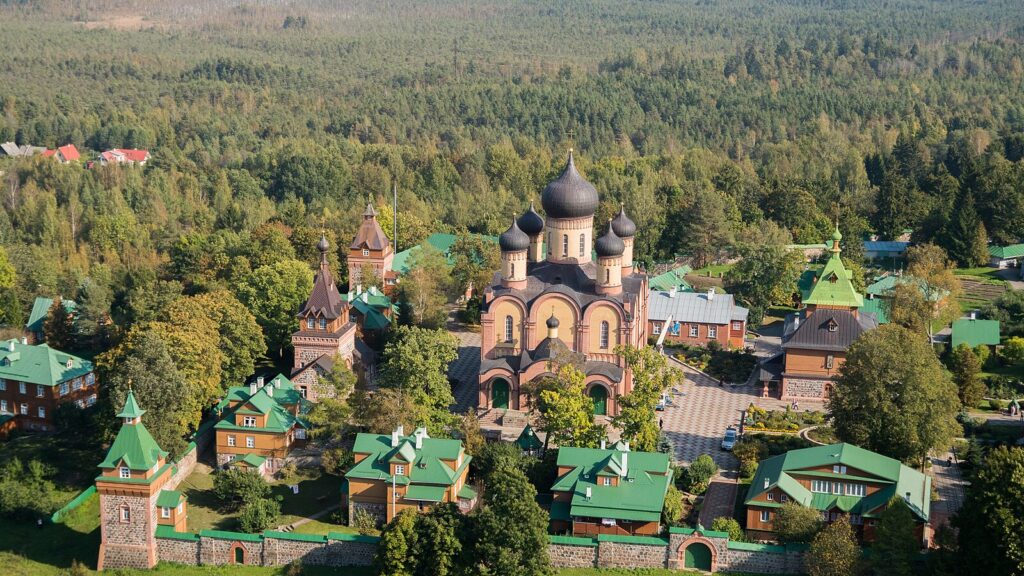
Kuremäe Monastery
The Fate of Monastic Archives
Regarding the archives of Orthodox monastic communities once under Constantinople’s jurisdiction, Professor Rohtmets confirms Metropolitan Stephanos’s view that most were confiscated. While a few older documents survive in Estonia’s state repositories, the majority of archival material—especially concerning the Soviet period—remains under the control of ROC institutions and is not publicly accessible.
Conclusion
The testimony of Professor Priit Rohtmets offers a powerful window into the entanglement of religion, empire, and political authority in the Soviet and post-Soviet landscape. His analysis demonstrates that, far from being a passive institution, the Russian Orthodox Church has long served as a partner in the projection of “imperial” influence. At the same time, Estonia’s religious communities—Lutheran, Catholic, and Orthodox—have been shaped by a complex interplay of repression, adaptation, and cultural resilience.
The legacy of these interactions continues to shape geopolitical tensions today, particularly in the Baltic region, where questions of jurisdiction, historical narrative, and ecclesiastical identity remain deeply intertwined with sovereignty and national security.
Diane Niquin